For decades, the food and hospitality industry has focused on products. Better ingredients. Better recipes. Better service. Better concepts. And rightly so. But as consumers become increasingly experience-driven, a new question emerges. What do guests actually remember? Spoiler-alert: it’s rarely the product alone. Let’s take a deep dive into immersive food experiences with tech expert Danny Han.
What stands out most? Was it the dish itself? Or was it the story behind it? The people they shared it with? The emotions they felt? The place they found themselves in?
Research consistently suggests that memorable experiences are rarely defined by a product alone. Instead, they emerge through a combination of emotions, stories, social interactions, and sensory cues that together create meaning.
Food is becoming more complex
Today's consumers expect more from food than nourishment or enjoyment alone. They want to know where ingredients come from. They want to understand sustainability claims. They want authenticity, transparency, local identity, and meaningful stories. Yet many of these elements are invisible.
How do you show biodiversity on a plate? How do you communicate regenerative agriculture through a menu description? How do you help a guest understand the cultural heritage of a recipe that has evolved over generations? The industry has largely responded by providing more information. More labels… More explanations… More storytelling… But information does not automatically create engagement. Experiences do.
From telling to experiencing
Imagine sitting in a restaurant while virtually standing in the Tuscan vineyard where your Sangiovese wine was produced. Imagine following the journey of a cocoa bean before tasting a piece of chocolate. Imagine stepping inside a historical kitchen while learning about the culinary traditions that shaped a region's food culture.
Technology can help create this. When discussing technologies such as virtual reality, augmented reality, artificial intelligence, or spatial computing, conversations quickly focus on the technology itself. In reality, technology is merely a tool. Guests do not care about the headset. They care about what the experience allows them to feel, understand, and remember.
Perhaps the strongest example in hospitality today is Le Petit Chef, now operating in more than 70 restaurants worldwide. Through projection mapping, a miniature animated chef appears on the dining table and guides guests through a story for each course. The food, service choreography, sound, and visuals are synchronized into a single narrative experience. The success of the concept comes from using technology as a storytelling device, not as a gimmick. Guests do not leave talking about the projector specifications. They leave talking about the journey they experienced. The objective is not technology – the objective is connection. This distinction is important.
Research on narrative transportation demonstrates that individuals become more emotionally engaged when they feel transported into a story. Rather than simply receiving information, they temporarily experience an alternative reality. And that matters. Because emotional engagement is often the first step towards creating lasting memories and meaningful behavioral change.
What we have learned from our research
Over the past years, our team at the research centre Future of Food at Hotel Management School Maastricht has investigated how immersive experiences can influence consumer engagement across food and hospitality contexts. One of the key conclusions? Immersion is rarely created by technology alone. In our Immersive Experience Framework, immersion emerges through the interaction of multiple dimensions: the environment, the narrative, social interactions, emotions, and sensory stimulation.
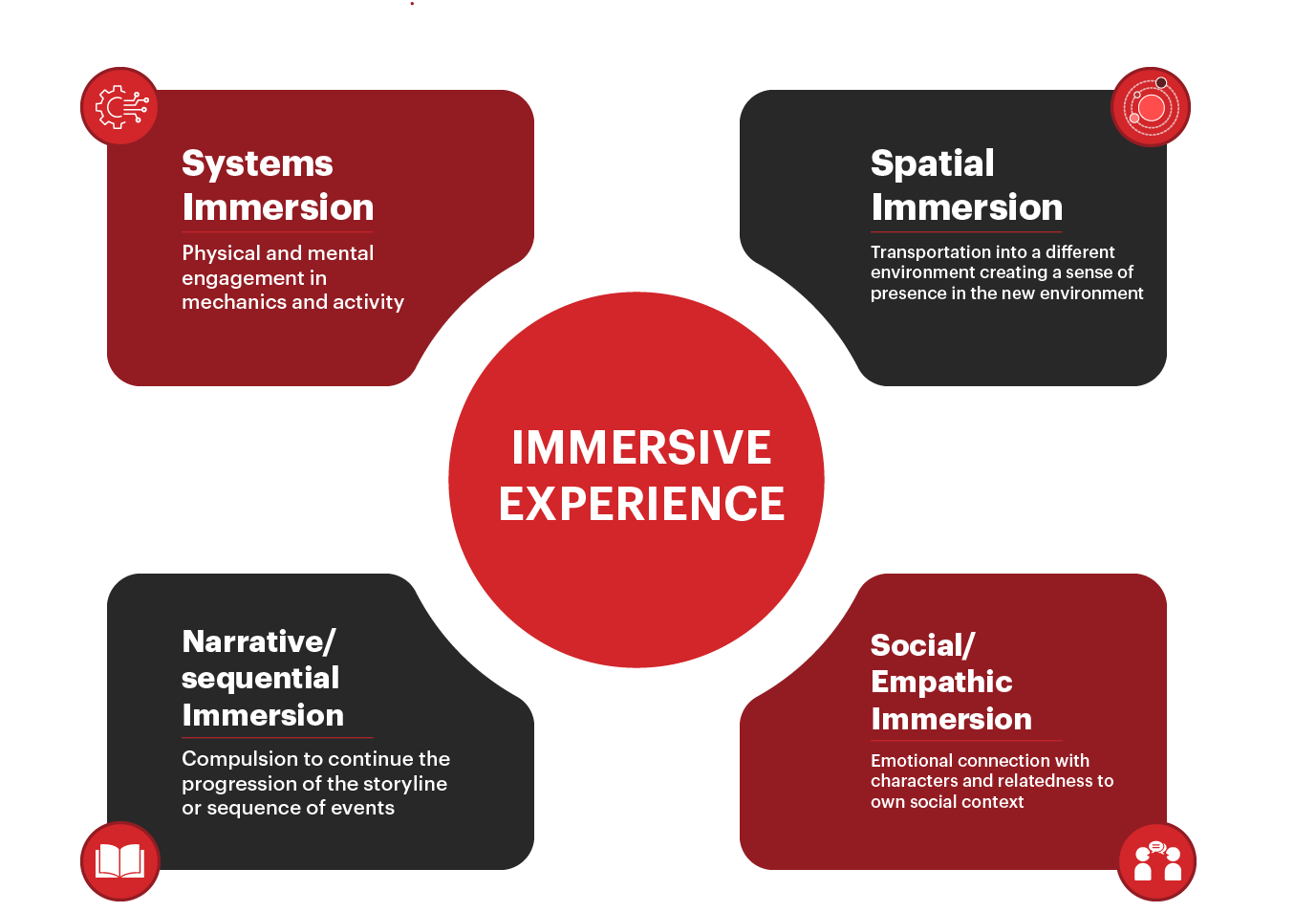
Technology is only one piece of the puzzle. In fact, some of the most successful immersive experiences are those in which the technology almost disappears. The guest stops noticing the medium and becomes absorbed in the experience itself. A strong example is 7 Paintings in Rotterdam, where projection mapping, storytelling, music, and gastronomy are combined to transform a dinner into an immersive artistic journey inspired by famous painters. Guests do not remember the technology itself; they remember the emotions, stories, and interactions that make the experience meaningful and memorable.
This insight has shaped projects within our Food Experience Lab, where immersive technologies are combined with storytelling, gastronomy, multisensory design, and behavioral science to create experiences that help consumers engage more deeply with food systems, sustainability challenges, and cultural food heritage.
A shift that hospitality cannot ignore
Across the industry, a quiet shift is taking place. Restaurants are becoming stages for storytelling. Tourist destinations are using immersive experiences to communicate cultural heritage. Food brands are looking for new ways to make sustainability tangible. Hotels are exploring how technology can enrich rather than replace hospitality. The common denominator in all those is not technology: it is experience design.
As technologies continue to evolve, artificial intelligence will make experiences more adaptive. Spatial computing will increasingly blend digital content into physical environments. Multisensory technologies will create richer and more personalized interactions. And yet, none of these developments answer the most important question.
How do we create experiences that truly matter?
The future of food experiences will not be defined by the sophistication of immersive technology. It will be defined by how effectively we use technology to strengthen human connection.
Connection to food.
Connection to place.
Connection to culture.
Connection to one another.
What does this require? It requires a shift from technology-driven innovation to experience-driven innovation. Food service professionals must design around human needs, emotions, and social connections, using technology only where it adds genuine value. The most successful innovations will not be those that are the most technologically advanced, but those that create the most meaningful experiences. Ultimately, guests rarely remember the technology. They remember how the experience made them feel. And perhaps that is the most important lesson immersive technologies have taught us so far.
Further reading:
Han, D.-I., Melissen, F., & Haggis, T. (2023). Immersive Experience Framework: A Delphi Approach
Lees ook
We need to move from ‘where can we replace people?’ to ‘where do people matter most?’
About professor dr. Danny Han
Dr. Dai-In Danny Han is Professor at the Research Centre Future of Food at Zuyd University of Applied Sciences in Maastricht and Senior Research Associate at the Food Evolution Research Laboratory, University of Johannesburg. As an internationally recognized expert in the application of immersive and intelligent technologies, his work focuses on the intersection of food, hospitality, and technology. He supports organizations in translating emerging technologies into meaningful, consumer-centred experiences.