By the tens of thousands, they move through the streets of Shanghai: delivery drivers bringing meals, coffee, and groceries. What’s happening here goes beyond anything we’ve seen in Europe or the United States. This is no longer just a delivery market, it’s a system. Food Inspiration saw firsthand what the next generation company restaurants will look like: a kiosk where all lunches are delivered.
It starts with what you don’t hear. No roaring engines, no exhaust fumes. Just the soft hum of electric scooters. Anyone delivering meals in Shanghai rides an electric scooter. Not by choice, but because of regulations that have virtually eliminated other forms of two-wheeled traffic, such as those with combustion engines. The result is a city where millions of deliveries take place without the noise and stench you’d expect.
Around lunchtime, the system reaches its peak. In a food court at one of the many shopping malls, we watch the system in action. A man, wearing a T-shirt with the poetic slogan “Where Dreamers Become Doers,” moves quickly and purposefully. His arms are full of colorful lunch bags. At a sushi outlet, he scans his last order, continues on his way, and disappears toward the parking lot. Time is everything. Every second counts here.
Outside, a swarm of delivery scooters is streaming into the city. Destination: offices, apartments, stores. At one office building, we see the logistics puzzle being solved in its most efficient form. In front of the entrance stands a sleekly designed kiosk with lockers the size of a microwave. No lines, no personal handoffs. The delivery person places the lunch in a locker, and the customer retrieves it themselves.
What stands out is the attention to presentation. The lunch bag isn’t just functional packaging, but a gift to unwrap. Colorful, well-designed, almost festive. With a little imagination, you can see the future of the corporate cafeteria here: digitized, decentralized, and entirely demand-driven: the menu features offerings from just about every restaurant and food outlet in the city. That’s more than 100,000 options.
Inside the office building, the pattern repeats itself, but on a larger scale. Walls lined with lockers. A constant stream of delivery people and office workers. A security guard maintains order. Scan, open, take. Meals are eaten elsewhere: at a desk, in a lounge, outside on the street. What stands out is not only the efficiency, but above all the lack of human contact. This is hospitality without the human touch.
Supermarkt and delivery
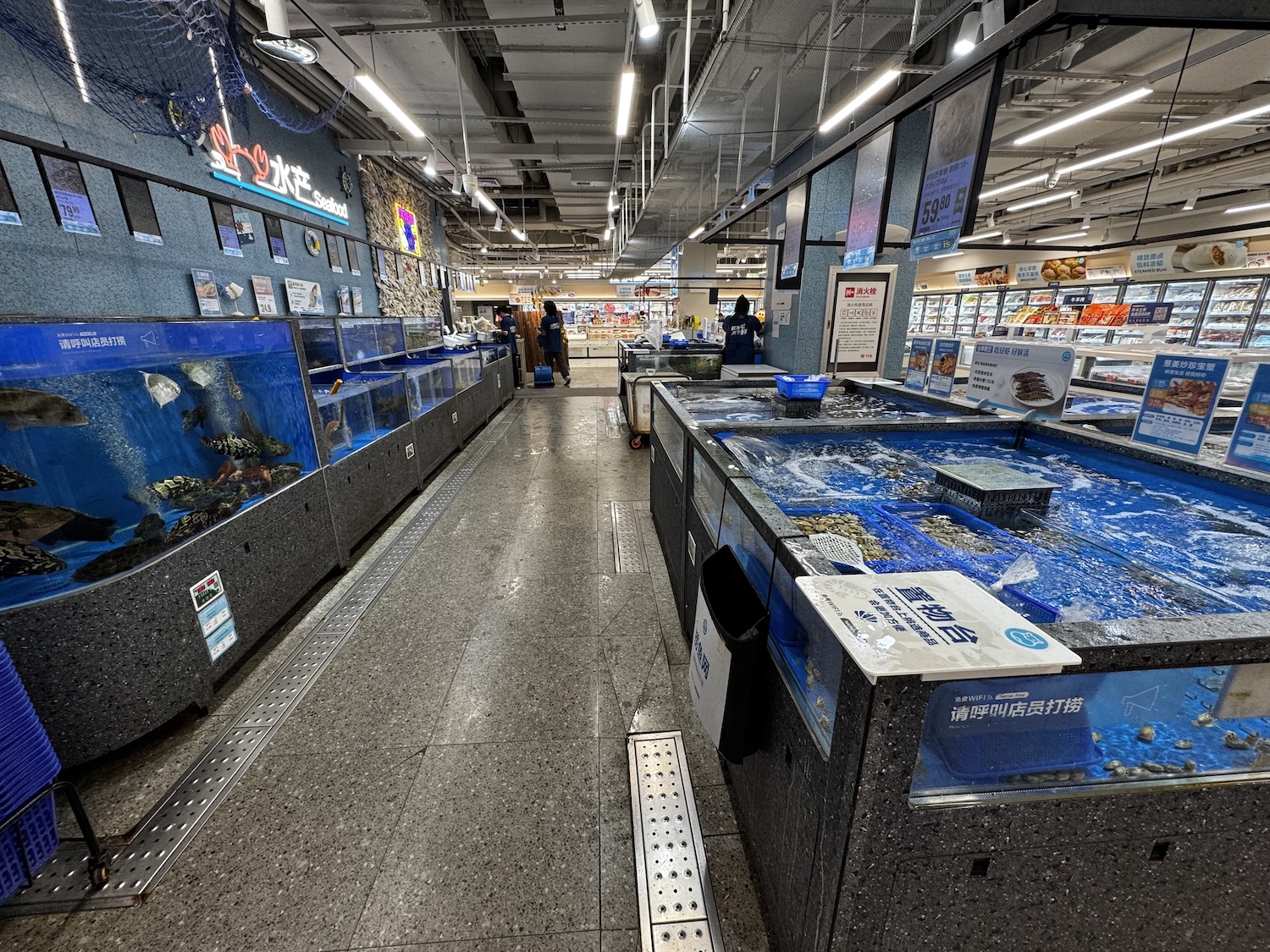
In a supermarket located in the recently opened Parc Avenue Central Shopping Center, we see another side of the same system. Employees are picking orders at a breakneck pace. Tens of thousands of steps a day are likely the norm here. The volume of orders is high, and the floor area is vast.
The fish department immediately catches the eye. Walls lined with aquariums full of live fish. Here, “fresh” literally means “alive.” Employees pack the fish into bags of water so they can be prepared at home. Customers who still do their own grocery shopping scoop live shrimp out of the aquarium themselves. It doesn’t get any fresher than that.
Once an order is complete, the filled bag is hung on a rail system attached to the ceiling. The bag moves automatically to the distribution area. From there, a delivery person takes over. It’s ingenious – we haven’t seen this method of in-store transport before.
The city of delivery drivers
China has become the world’s largest delivery economy. More than ten million delivery drivers handle between 60 and 100 million meals daily, in addition to countless package deliveries. In cities like Shanghai and Beijing, delivery is no longer a service, but infrastructure.
The linchpin of this system is the smartphone. Apps like Alipay and WeChat control everything: ordering, paying, tracking, and rating. You can’t function here without a smartphone. Charging stations are everywhere, and the network is fast and flawless. The screen is your gateway to the city.
A meal costs 20 to 40 RMB (about €2.50 to €5). Delivery fees are low. Behind this efficiency lies a harsh reality. Many delivery drivers are migrants who work long hours to earn an income of 7,000 to 11,000 yuan per month (€900 to €1,400).
The end of ghost kitchens
Anyone who thought ghost kitchens were the future will come to a different conclusion in Shanghai. In an underground shopping mall, we see the remnants of that promise: closed units, deserted corridors. Here and there, a kitchen is still operating, but without visibility, without a brand experience.
According to local experts, the market is shifting back toward a physical presence. Kitchens that are visible. Where you can pick up your order. Where you might even stay to eat. The reason is simple: connection with the brand.
In China an outlet can easily be run by a single person. Security is largely ensured through video surveillance. In the Netherlands, that’s unthinkable. Fewer or no staff means lower costs for the many small business owners in Shanghai. According to local experts, the underground shopping center full of ghost kitchens has been overtaken by time. In Shanghai, the future is not only imagined, but also built, all in real-time. In a blink of an eye, the market will have moved on.
Lees ook
How China’s food metropolis makes our focus on innovation shift towards the East