A few years ago, a hotel in Japan became globally known for replacing its front desk staff with robots. It made headlines and attracted curiosity. And then quietly, it started bringing humans back. Not because the robots stopped working. But because the experience did. This pattern is repeating itself across hospitality businesses. It raises a question: when are robots actually improving hospitality?
From robot waiters in European casual dining to delivery robots in Asian hotels, automation is moving from novelty to necessity. All in time when labor pressure is still not easing. Wage costs are still not stabilizing. And operators are no longer asking if they should automate but how far they can go. And yet, beneath this momentum, a more uncomfortable question is emerging. Are we actually improving hospitality? Or are we slowly redesigning it into something else?
I’ve seen many discussions in the industry framing it in provocative tones.
Robots versus humans.
Efficiency versus experience.
Cost versus quality.
But that framing is too simplistic to be useful. Because hospitality has never been defined by tasks alone. It is defined by how those tasks are experienced. A perfectly delivered plate is not memorable. A perfectly timed, human interaction might be.
“Many automation efforts misfire, because the experience around it remains unchanged.”
This is where many current automation efforts begin to misfire. Not because the technology is insufficient, but because the experience around it remains unchanged. We try introducing robots into service flows that were fundamentally designed for humans. We automate interactions without considering what those interactions are meant to achieve in the first place. And we measure success in operational terms, while the actual impact unfolds perceptually and emotionally.
I see this tension play out consistently when setting up and executing our own research studying food service robot interactions and service failures in our Teaching Hotel Chateau Bethlehem and their effect on the service experience. When we study how guests and employees interact with service robots, the outcomes are rarely determined by what the robot does. They are shaped by how the interaction is interpreted by guests, by employees. When a robot makes a mistake, guests do not evaluate it purely on performance. They evaluate the respective intention: Was it clear what the robot was trying to do? Was the interaction understandable? Did it feel awkward, or surprisingly engaging?
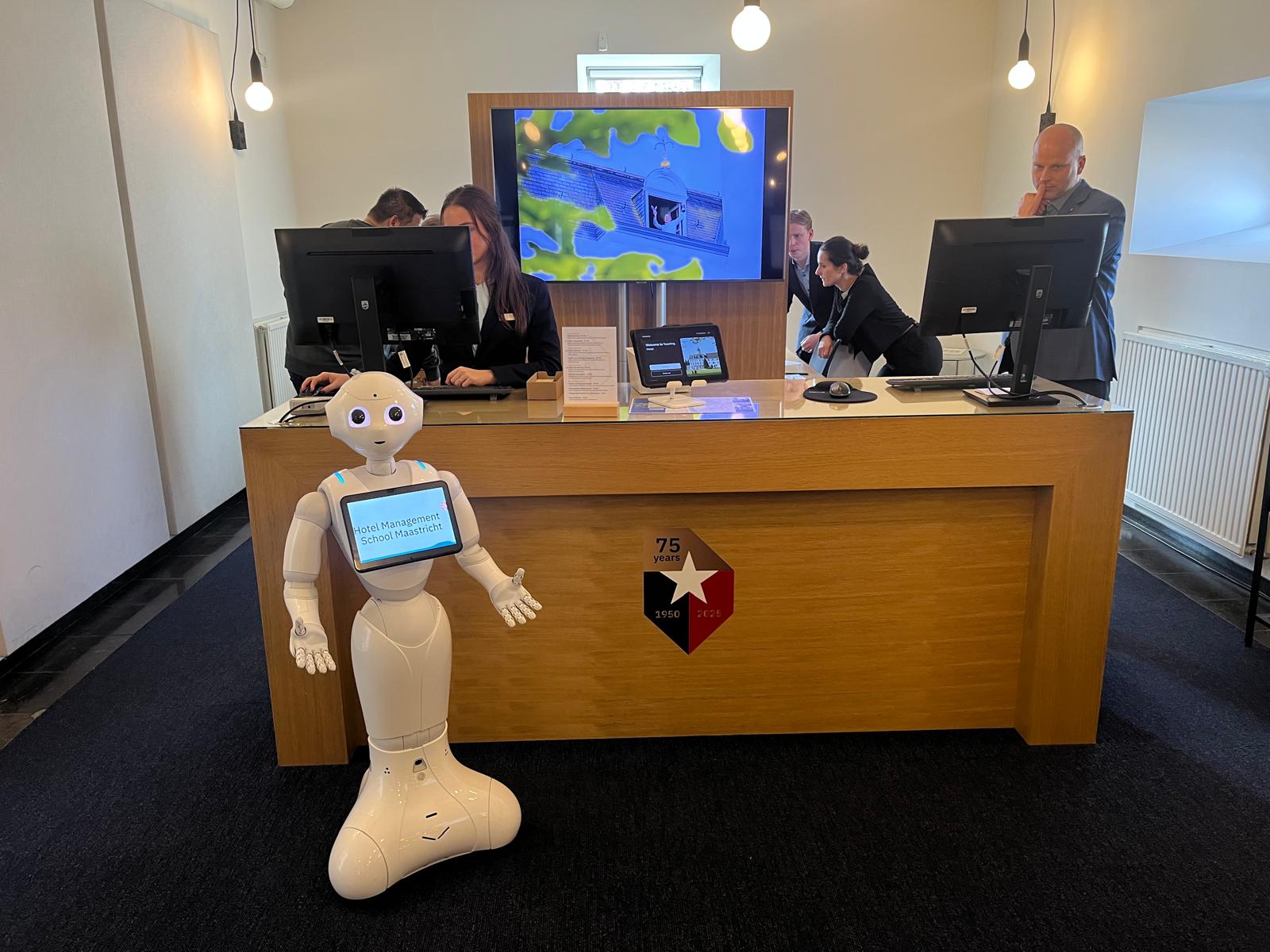
In one of our ongoing research projects using the Pepper Humanoid, we experiment with how robots communicate. Not only in terms of clarity, but also tone of voice. We want to know what happens when a robot uses humor, acknowledges a mistake or attempts to replicate human conversational patterns and related emotional signals.
What we observe may not be a linear improvement in experience. In some cases, adding ‘human-like’ elements are expected to increase trust and satisfaction. In others, it creates discomfort. Because expectations are raised that the robot cannot fully meet. This is the paradox the industry is currently navigating. We try to humanize machines, while simultaneously removing humans from the experience. And in doing so, we blur the very thing that makes hospitality meaningful.
The issue, therefore, is not whether robots belong in hospitality - They already do.
The issue is where, and how, they belong.
When we shift the perspective from substitution to intention-driven design, a different logic emerges. We already understand that not all moments in a service journey carry the same weight. Some are functional. Others are emotional. Some require speed. Others require sensitivity. Respecting these differences matters more than the technology itself.
“We need to shift focus from where can we replace people, to where do people matter most”
Back-of-house operations, such as kitchen coordination, transport, or cleaning, benefit immediately from automation. Precision, consistency, and reliability create direct value without altering how the guest perceives the experience.
Front-of-house moments are very different. A welcome is not just a greeting. It is the beginning of a relationship. A recommendation is not just information. It is a signal of care. A service recovery is not just a correction. It is a test of trust. When these moments are automated without intention, the experience does not become more efficient. It becomes thinner.
This is where our conversation needs to evolve. From ‘where can we replace people?’ to ‘where do people matter most?’ Because once that question is answered, technology can be positioned differently. Not as a visible substitute for hospitality, but as the system that enables it. A robot that simply replaces a human interaction removes a layer of meaning. A robot that ensures that interaction happens at the right moment, under the right conditions, protects it.
That distinction is subtle, but very fundamental. And it requires a different kind of decision-making. Not driven by capability, but by designing the flow of the experience and understanding where emotional peaks occur. It allows us to identify where friction should be removed, and where it should remain, because it signals attention, craft, uniqueness, or care.
This is where immersive and service experience design become critical. They allow us to map not only what happens, but how it is perceived. Once we understand perception, we can design automation accordingly.
“When front-of-house moments are automated without intention, the experience becomes thinner”
The anticipated risks are already visible. Experiences are becoming very efficient, but forgettable. Interactions with guests are becoming more convenient and seamless, but distant. Operations are increasingly optimized, while the essence of hospitality quietly erodes.
The operators who will navigate this transition successfully are not those who adopt the most technology. But it’s going to be those who understand where technology belongs, and where it does not.
It brings us back to a question that is becoming increasingly difficult to ignore. Are we automating to reduce cost, or are we redesigning the experience to protect what hospitality actually is? Because robots will not improve hospitality, but better-designed experiences might.
About professor dr. Danny Han
Dr. Dai-In Danny Han is Professor at the Research Centre Future of Food at Zuyd University of Applied Sciences in Maastricht and Senior Research Associate at the Food Evolution Research Laboratory, University of Johannesburg. As an internationally recognized expert in the application of immersive and intelligent technologies, his work focuses on the intersection of food, hospitality, and technology. He supports organizations in translating emerging technologies into meaningful, consumer-centred experiences.

Lees ook
Meet our new correspondent: technology expert Danny Han