Eating out is getting more expensive. Guests know it. Operators know it. And increasingly, consumers are becoming more selective about when and where they spend their money. The instinctive response is often to compete on price: smaller menus, value deals, happy hours and promotions. But what if restaurants would focus on making it more worth it instead?
The changing meaning of value
Price and value are not the same thing. Restaurant prices have increased considerably over the past years. In the UK, for example, average restaurant spend per head has risen from £25.35 in early 2022 to £30.08 in 2026. And some consumers have responded by eating out less frequently.
At the same time, consumers still appear willing to spend on experiences they perceive as distinctive. OpenTable's 2026 research, for example, found that more than half of American consumers would pay a premium for a dining experience offering a unique vibe. Maybe consumers are not simply becoming more price-sensitive. Maybe they are becoming more experience-sensitive.
Price and value are not the same thing
The food does not end at the plate
We are used to thinking about food as a product. A chef selects ingredients, applies culinary techniques, creates a dish and puts it on a plate. Everything surrounding that plate – the lighting, music, tableware, smell, people and interior – becomes the setting in which the food is consumed.
But scientifically, that distinction is difficult to maintain.
Decades of multisensory research show that what we experience as flavor is constructed from information coming from multiple senses. What we see, hear, smell and feel can influence what we subsequently perceive in our mouths. Change the sound and the same food can be experienced differently. Change the visual context and expectations can change.
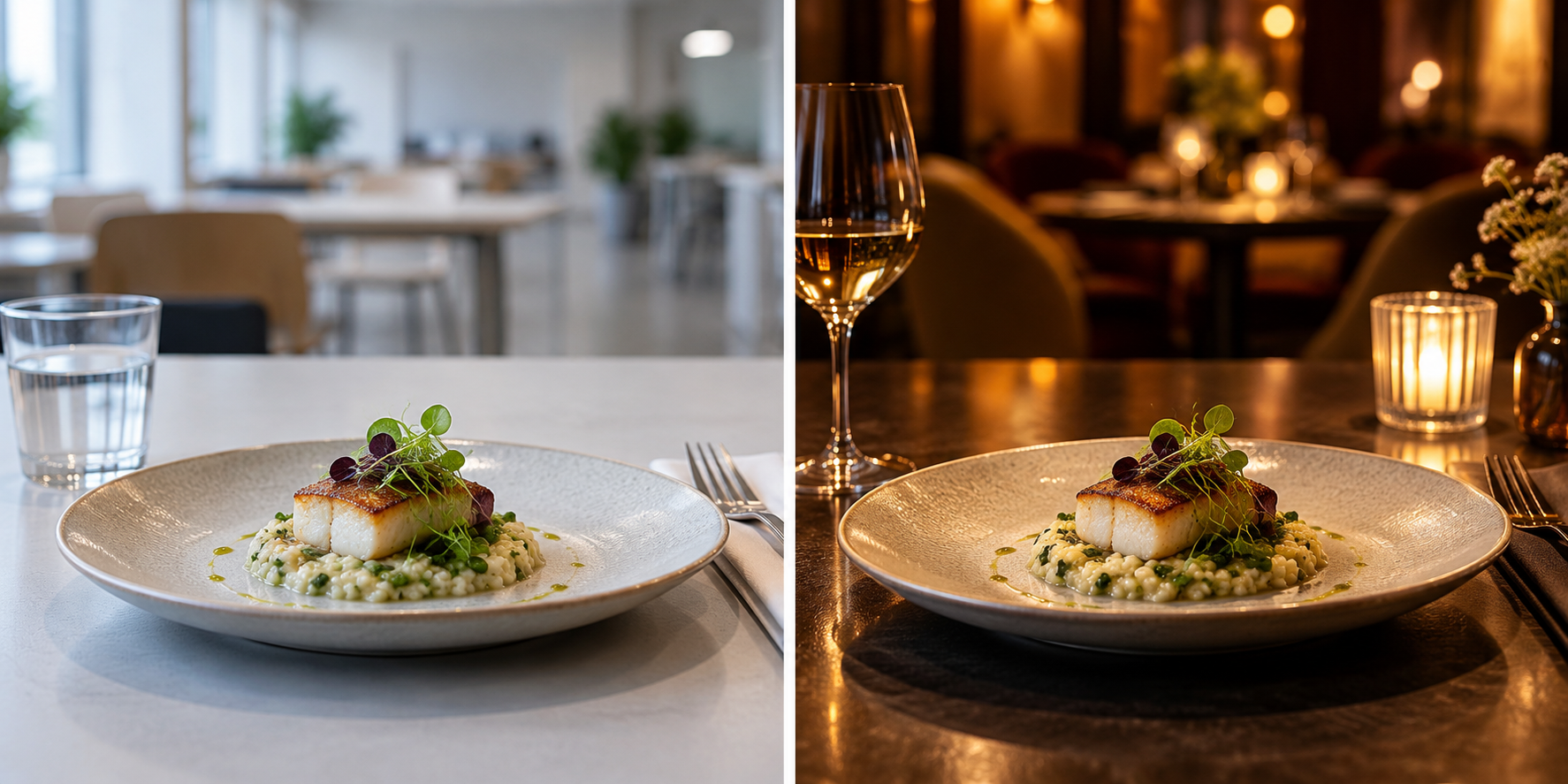 The food itself has not changed. The experience of the food has. So perhaps the environment isn't just the backdrop to the product. Perhaps the environment is part of the product.
What if the restaurant becomes part of the recipe?
Chefs carefully consider acidity, sweetness, texture, temperature, aroma and presentation. Each element is selected because it contributes something to the experience of the dish. But what happens one meter beyond the plate? Suddenly, many of those same sensory considerations become "interior design", "atmosphere" or "marketing". That separation makes no sense.
If sound affects perception, why should sound not be considered when designing a dish? If the visual environment changes expectations, why should the environment only be designed after the menu has been created? If storytelling changes how people interpret what they eat, why should the story simply be added to the menu as a paragraph of text?
This doesn't mean chefs should suddenly become sound designers or neuroscientists. It means we may need to broaden our understanding of what food experience design is. Instead of asking: ‘What atmosphere fits our restaurant?’, we might start asking: ‘What environment makes our food experience stronger?’
Trying too hard to create an experience can sometimes get in the way of experiencing it
More experience does not necessarily mean a better experience
If sound can influence taste, environments can influence perception and storytelling can create meaning, why not simply add more of everything? Our own research provides a useful warning.
In a recent study with Marissa Orlowski, Silvia Abreu e Silva and Anna Mattila, we investigated wine tasting in two immersive environments: a VR headset and our projection-based CAVE environment. We expected relatively straightforward effects. We didn't find them. When we went back to participants and asked what had happened, their answers were much more interesting.
Sometimes the very things we had introduced to create immersion became barriers to it. Some participants became conscious of the technology. Others focused on what they thought they were supposed to experience. The presence of other people mattered. Even the timing and structure of the experiment could interrupt the process of becoming immersed.
We describe one of these effects as Immersion Inhibition Bias: when making people conscious of the fact that they are supposed to become immersed can actually interfere with their ability to do so.
There is a lesson here far beyond VR: Trying too hard to create an experience can sometimes get in the way of experiencing it. Think about the sustainability story that takes five minutes to explain before guests can finally eat. The projection that is so spectacular that nobody notices the dish. The server explaining every carefully designed detail before guests have had the chance to discover anything themselves.
Technically, we have added more "experience". But have we created more value?
The goal should not be more stimulation, but better orchestration
Experience needs orchestration
Our senses don't operate independently. The brain continuously combines what we see, hear, smell, touch and taste into an overall perception. That means adding more sensory stimulation isn't necessarily better. The goal should not be more stimulation, but better orchestration.
Perhaps chefs and experience designers have more in common than we think. A chef doesn't improve a dish by continuously adding ingredients. The chef decides what belongs, what doesn't and how individual elements work together. We could design restaurant experiences in exactly the same way. Sometimes the right intervention might be projection mapping or spatial audio. Sometimes it might be storytelling, different tableware or lighting. And sometimes, the best design decision might be to add absolutely nothing.
For decades, restaurants have engineered menus around margins, placement, descriptions and price. But as eating out becomes more expensive and guests become more selective, we may need to complement menu engineering with experience engineering: not asking how much more we can add, but what guests should feel, notice and remember, and which elements genuinely contribute to that.
A small change in lighting, tableware, storytelling or service choreography can make the value of a hotel breakfast, a healthier lunch or a plant-forward dish more perceivable. After all, restaurants no longer compete only with the restaurant next door, but with an increasingly attractive evening at home.
So, before asking how to make the dish cheaper, we should ask a different question: what would make the experience worth more?
About professor dr. Danny Han
Dr. Dai-In Danny Han is Professor at the Research Centre Future of Food at Zuyd University of Applied Sciences in Maastricht and Senior Research Associate at the Food Evolution Research Laboratory, University of Johannesburg. As an internationally recognized expert in the application of immersive and intelligent technologies, his work focuses on the intersection of food, hospitality, and technology. He supports organizations in translating emerging technologies into meaningful, consumer-centred experiences.