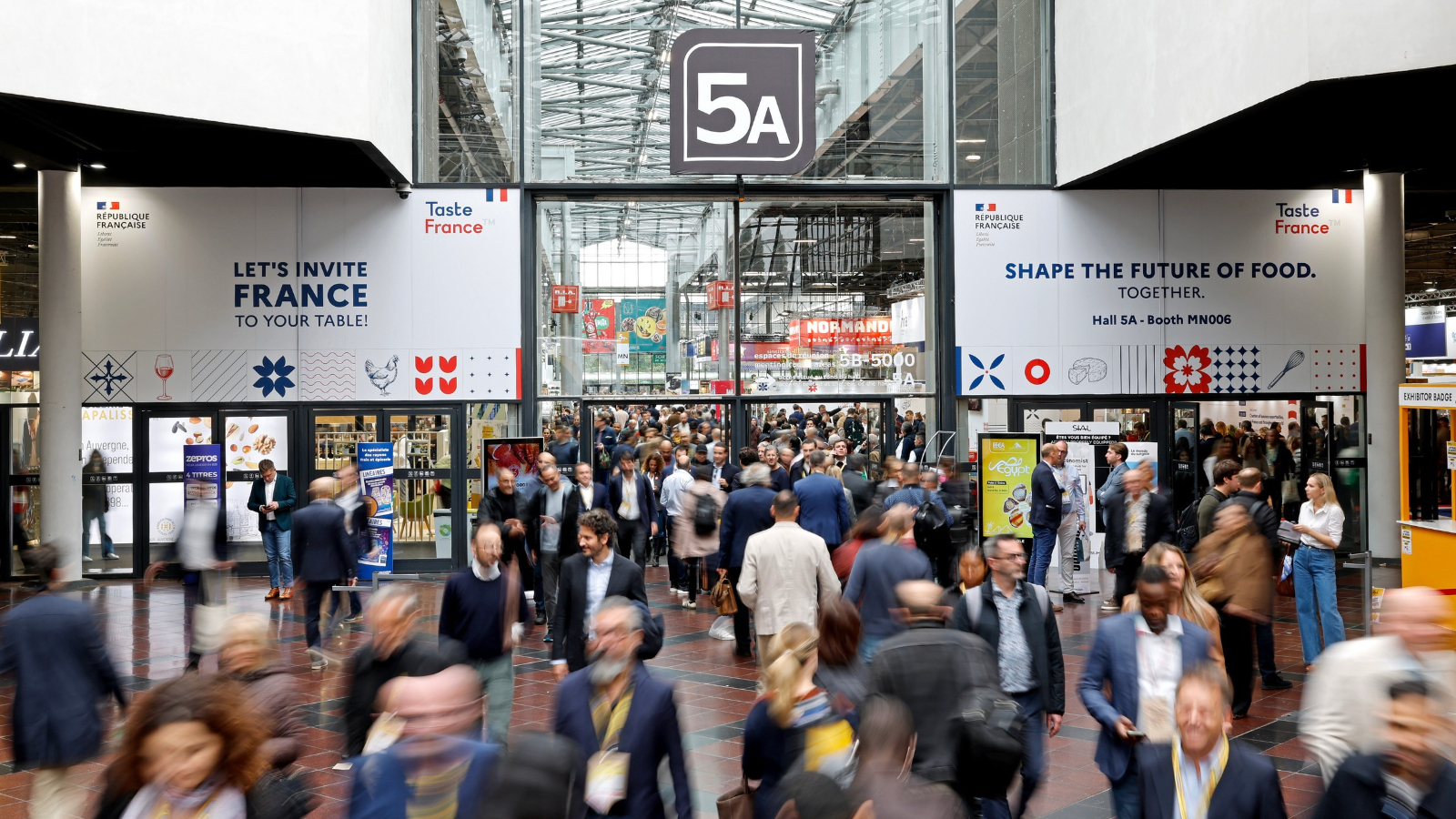
Consumers want to eat healthier, make more sustainable choices, discover new flavors and enjoy greater convenience. Preferably, all at the same time. But between what people say matters to them and what they ultimately buy lies a complex mix of price, availability and everyday habits. Food Inspiration visited SIAL Paris 2026, one of the world’s largest biennial food industry trade shows, to explore the latest product innovations answering to this multitude of consumer needs and the opportunities they create for both food retail and foodservice.
SIAL Insights 2026
Held from October 17–21, SIAL Paris brought together over 300,000 visitors from around the world, with some 8,000 exhibitors showcasing roughly 400,000 products.
Ahead of the show, SIAL published SIAL Insights 2026, a trend analysis based on research by Kantar, ProtéinesXTC and Circana. Kantar focuses primarily on consumer needs, ProtéinesXTC on product innovation and Circana on purchasing behavior. During the trade show, researchers presented their main findings, supplemented with current market data and product examples.
Together, their data identifies ten developments shaping the international food market, ranging from functional foods and gut health to new snacking occasions and affordable innovation.
Lees ook
The SIAL F&B trade show highlights the trends that will impact the future food market
Pleasure remains the starting point
With so much attention on health claims and sustainability ambitions, it can be easy to forget what food ultimately comes down to. According to Karine Perrot, Senior Expert Director Brand Strategy & Innovation at Kantar, pleasure remains a fundamental driver. Above all, food still needs to taste good and be enjoyable.
Kantar’s global consumer research also shows just how fluid eating behavior has become. Eight in ten respondents say they have changed their purchasing or consumption habits over the past two years. According to Perrot, that means companies need to anticipate not only long-term trends, but also much faster shifts in consumer behavior.
The meaning of pleasure itself is changing as well. Consumers are no longer looking only for familiar comfort foods or traditional indulgent products. They are also seeking bold flavors, unexpected textures and inspiration from other food cultures. According to SIAL Insights, 68% of consumers worldwide are interested in products offering new textures, flavor variations and sensory experiences.
Xavier Terlet, Senior Advisor at food innovation consultancy ProtéinesXTC, sees this trend reflected directly in the innovations presented at SIAL. Indulgence, he says, is becoming less exclusively about guilty pleasures or premium ingredients and increasingly about the overall eating experience: color, texture, unusual sensations such as heat or smoky flavors, and products with strong visual appeal. One example is ube, the bright-purple yam from the Philippines, which appeared in a striking number of new product launches at the show.
Global cuisines are another important part of this development. Terlet points in particular to the growing influence of Korean food. Restaurants play an important role in introducing consumers to new cuisines, he says. “The first time consumers eat Korean food, they often discover it in a restaurant. Then they want to recreate that experience at home and start looking for Korean products in the supermarket.” That means foodservice does more than follow international food trends: it can actively accelerate them.
Health is becoming much more specific
Alongside pleasure, health continues to gain importance. But the definition of “healthy” is becoming increasingly specific. Nutritional benefits are now among consumers’ most important purchase criteria, directly behind quality and price, according to Perrot. At the same time, broad messages such as “this is good for you” are increasingly giving way to specific benefits: better digestion, more energy, muscle recovery or support during a particular stage of life.
Terlet sees two developments unfolding simultaneously in today’s foodservice offering:
-
On one side, consumers are looking for simpler, less heavily processed foods. The debate around ultra-processed foods is increasing interest in straightforward recipes, shorter ingredient lists and less processing.
-
On the other, the market is moving toward hyper-functionality. Products are being developed specifically for athletes, women going through menopause, older consumers or people looking for support with focus, memory or energy. As a result, the boundary between food and dietary supplements is becoming increasingly blurred.
Terlet sees the same shift among entries for the SIAL Innovation Awards. In previous editions, he says, roughly ten to fifteen entries would have closely resembled functional foods or supplements. This year, that number was around 80. What is particularly interesting is that these functional benefits are increasingly moving into everyday foods, from beverages and dairy products to ready meals. It reflects a broader development identified by SIAL Insights: food is increasingly being tailored to individual lifestyles, life stages and health goals.
What does this product do for me?
Over the past few years, the protein boom has dominated new product launches commercially. Emily Mayer, Business Insights Director at Circana, illustrates the growth using the French market: according to Circana, protein-enriched products now generate around €770 million in sales in France, up 43% in a single year.
Terlet does add an important caveat. Strong commercial demand for high-protein products does not necessarily mean that the average consumer has a nutritional need for more protein. “The market is flooded with protein-enriched products today. But for the vast majority of the population, there is no actual protein deficiency.” Fiber is a different story, he says. Many consumers eat less fiber than dietary recommendations advise. Terlet therefore sees significant opportunities for fiber-rich foods, prebiotics and other gut-health innovations.
Mayer also expects functional food to continue evolving. Today, products often revolve around one prominent ingredient or claim – high protein, added fiber or collagen, for example. In the next phase, she expects the desired outcome to become more important than the individual ingredient. For foodservice, that could significantly broaden the opportunity. Functionality no longer has to be limited to protein bars or sports shakes. It can become part of breakfast, lunch, snacks and complete meals.
Convenience is changing how we eat
Alongside health and pleasure, convenience is another major driver of changing eating behavior. Circana’s data from France shows how quickly the market is evolving. According to Mayer, 41% of French restaurant spending now takes place in the quick-service restaurant sector, compared with 34% in 2019. Grab-and-go and other snack-based solutions are also growing rapidly – even in a country with such a strong traditional food culture.
A similar shift is visible in the Netherlands. According to the Dutch Foodservice Institute (FSIN), convenience as the primary purchase motivation accounted for 31.5% of total Dutch food spending in 2025 – including food consumed at home, on the go and out of home. FSIN expects that share to reach 38.6% by 2035, overtaking routine as the most important purchase driver.
Traditional breakfast, lunch and dinner occasions are not disappearing, but they are increasingly being supplemented by more flexible eating occasions and snacks. Seven in ten consumers worldwide say they prefer food products that are easy to prepare or save them time.
And as the number of eating occasions expands, Mayer says it makes less and less sense to treat “snacks” as a single product category. Someone taking a small snack mid-morning to bridge the gap until lunch has different needs from someone looking for an energy boost at 4 p.m., grabbing something quickly while traveling or craving a treat on the couch at night. For product developers and foodservice operators, that creates an increasing number of distinct snacking occasions to address.
Consumers are not always consistent
Consumers may have clear preferences, but they switch between them just as easily depending on their mood or the occasion. Healthy choices can coexist perfectly well with moments of deliberate indulgence. A strong preference for locally produced food can sit alongside a love of international cuisines and new flavors. At SIAL, those last two tendencies were literally displayed side by side. An extensive showcase of regional French producers, grouped under the banner Régions de France, sat alongside halls filled with producers from virtually every part of the world.
Sustainable choices have to feel within reach
According to SIAL Insights, 69% of consumers see their food choices as a way to influence the world they want to live in. Although sustainability may not have the same momentum it did a few years ago, Perrot says consumer engagement has not disappeared. People still want to make more sustainable food choices, but price remains an important barrier.
Mayer therefore sees a more pragmatic form of responsible consumption emerging. A consumer who considers organic eggs too expensive, for example, may still choose free-range eggs: not the most sustainable option available, but a step that fits within their budget. “Consumers are bringing responsibility back to their own level: what can I do with the resources I have?”
The real challenge: delivering value at the right price
Ultimately, affordability will be a critical condition for the success of many of tomorrow’s food innovations. Mayer offers a striking figure from France: on average, an innovative new food product is 37% more expensive than an existing product in the same category. At the same time, food prices have risen sharply since 2021.
“Today, even more than before, it is about delivering the right value at the right price. Otherwise, you risk making innovation accessible only to a small group of consumers.” Innovation can command a premium, she argues, as long as consumers understand what they are paying extra for.
Terlet sees manufacturers responding in several ways. That does not necessarily mean simply accepting lower margins. Companies can also simplify recipes, introduce smaller formats and adjust portions more closely to actual consumption. “After all, a package that ends up half in the trash is expensive for the consumer as well.”
For foodservice, the same principle applies. Taste remains the starting point, but consumers increasingly expect products and concepts to deliver on convenience, health and sustainability as well. The real innovation challenge is to combine those benefits in a proposition that is accessible, convincing and worth the price.