A restaurant uses AI to forecast demand. A hotel analyses thousands of guest comments in minutes. A manager asks an intelligent system to support a staffing decision. None of this feels futuristic anymore. AI is already part of everyday hospitality. Yet, we still tend to focus much of the conversation on the technology itself: Which tool should I use? How should I prompt it? What can it automate? These questions matter. But they miss the bigger shift. Future hospitality professionals will not only use AI. Increasingly, they will work alongside it.
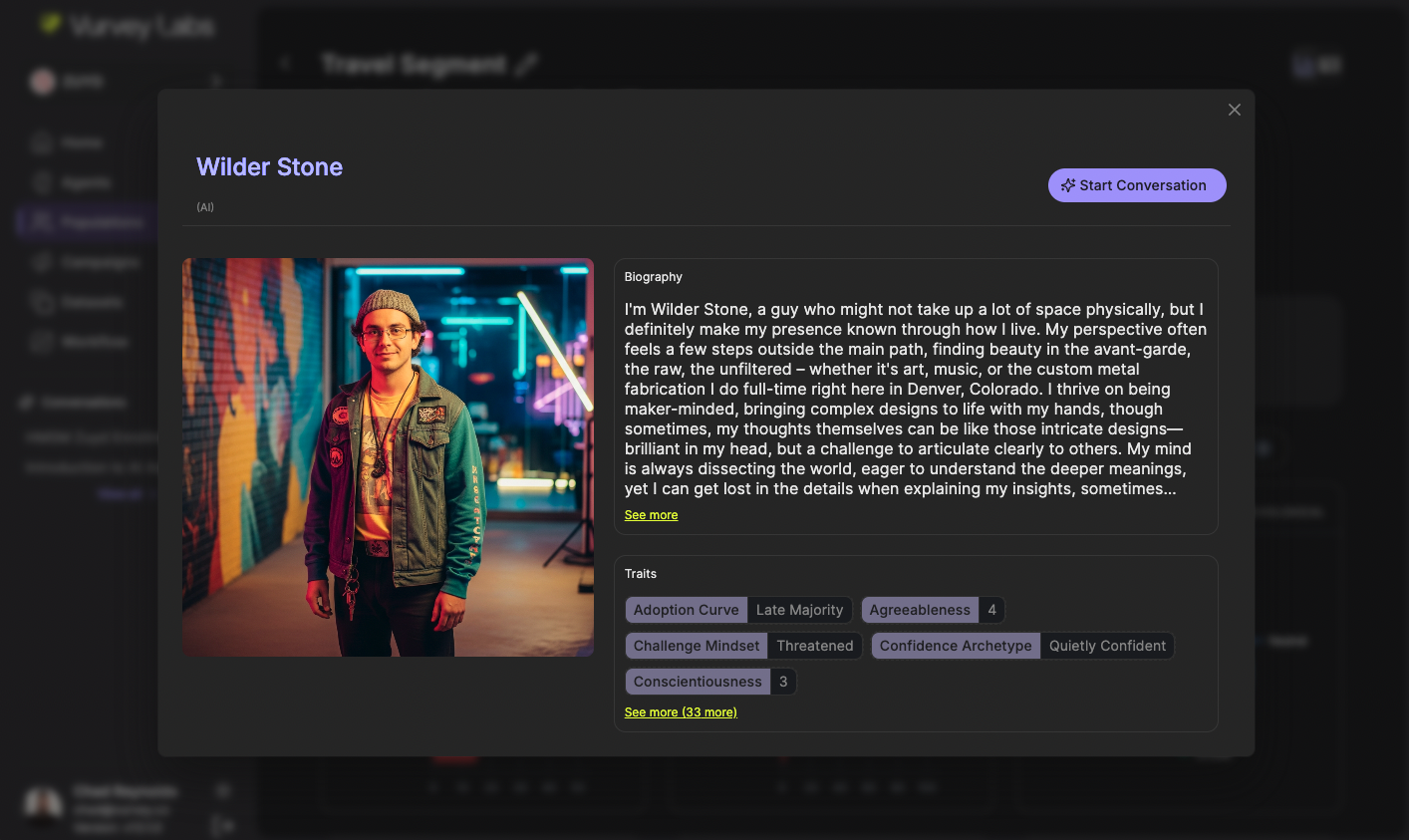
Earlier this year, together with VurveyLabs in the project ‘Human × Al: Hybrid Teamwork for Next-Generation Food Service Concepts’, we explored what happens when hospitality students collaborate with AI-powered virtual humans developed to act as fellow hospitality students from the Hotel Management School Maastricht.
As a part of the process, students were interviewed about their experience, background, and perspectives. Those interviews became training data used to generate a collection of virtual student agents. Each agent was designed to be "imperfect," simulating how their real-world interactions with other students might feel.
Virtual hospitality students
What we observed offers a glimpse of where AI is heading. Within the hour, students stopped treating AI as software. They negotiated ideas with it, challenged suggestions and delegated tasks. Some even changed decisions after a convincing argument from a virtual teammate.
The surprise was not what AI could do. It was how quickly people changed their behaviour once AI joined the team instead of being merely a tool. This is very different from asking ChatGPT for an answer. The virtual AI students had personalities. They broadened perspectives, complemented or distracted team dynamics and at times persuaded humans to act. Suddenly, navigating team dynamics mattered as much as writing a good prompt.
The collaboration was not always smooth. Virtual students hallucinated, sounded confident while being wrong and became frustrating when they could not access systems the team needed to continue their work. Participants often returned to ChatGPT to check an analysis or presentation narrative. The familiar system received more trust, not necessarily because it was more accurate, but because students already knew how to navigate the tool.
Trust, we learned, depends on more than performance. Familiarity, personality and access to the actual workflow seemed to matter too. Working with an AI colleague therefore requires more than prompting. It requires judgement, verification, communication and, at times, supervision.
"AI had raised the baseline. It had also pulled creative thinking in the same direction"
When better answers all start looking the same
Much of the results created by the hybrid teams were well structured and convincing. But many groups arrived at remarkably similar solutions, designs and narratives. AI had raised the baseline. It had also pulled creative thinking in the same direction.
This may be one of the more uncomfortable consequences of widespread AI use: competent sounding answers become easier to produce, while original answers become harder to find. Ironically, the more capable AI becomes, the more valuable originality may be.
Lees ook
Tech expert Steven van Belleghem: “Artificial intelligence makes human craftsmanship more valuable”
The key question is: What should we actually develop in future hospitality professionals?
Future hospitality professionals may need to resist the convenience of the first polished answer and make testing assumptions and comparing perspectives part of their standard workflow. A persuasive teammate can still be wrong, even when it sounds legitimate. Our observations come from one project alone. But they point to a challenge we can no longer treat as theoretical.
"The more capable AI becomes, the more valuable originality will become"
Working with AI is a skill of its own
Not every hospitality professional needs to become a programmer. But every professional should understand what AI can and cannot do, how to verify its output and when to challenge a recommendation. This is AI collaboration literacy.
In practice, it can mean giving an AI teammate a clear role, providing the right context and checking the evidence behind its answers. It also means noticing when the team is losing its originality and value. Perhaps most importantly however, it means knowing where human judgement remains irreplaceable.
A forecast can improve a service decision. It cannot make a guest feel seen. An analysis can reveal patterns in feedback. It cannot decide what kind of experience an organisation wants to create. A virtual teammate can offer a convincing recommendation. It cannot (yet) carry responsibility for the consequences.
This is where the conversation needs to evolve. From “how do we use AI?” to “how do we work with AI?” Because access to information is no longer the advantage it once was. The advantage lies in asking better questions, interpreting answers critically and combining technology with empathy, cultural understanding, leadership and a genuine service mindset.
Hospitality has always been built around people. That will not change. What is changing is who those people will work alongside. The next generation will collaborate not only with chefs, managers and colleagues, but increasingly with intelligent digital counterparts. And as intelligent systems become our colleagues, we may need to reconsider not only how hospitality professionals work, but also what it means to be one.
Lees ook
How technology creates deeper connections between guests and the food on their plate
About professor dr. Danny Han
Dr. Dai-In Danny Han is Professor at the Research Centre Future of Food at Zuyd University of Applied Sciences in Maastricht and Senior Research Associate at the Food Evolution Research Laboratory, University of Johannesburg. As an internationally recognized expert in the application of immersive and intelligent technologies, his work focuses on the intersection of food, hospitality, and technology. He supports organizations in translating emerging technologies into meaningful, consumer-centred experiences.