Operating a foodservice outlet at an airport is complex and costly. As a result, innovation can sometimes be challenging for operators. Nevertheless, the airport F&B landscape is evolving rapidly. Food Inspiration and Conceptional explore 9 key trends shaping the sector.
“At many airports, food and beverage is still an afterthought,” says Michiel Reuvers, Associate Partner responsible for Business Development at Conceptional, a strategic and creative F&B consultancy. In this role, he works on strategy development and master planning, as well as creating foodservice concepts for international airports. “People come to an airport to travel, not to eat and drink. In addition, retail often generates more revenue per square metre than foodservice, which is why many airports prioritise a broader retail offering over a well-considered F&B strategy. But that is beginning to change. The airport industry is waking up to the opportunities, and we are seeing more space being allocated to foodservice.”
The complexity of airport operations
Operating a foodservice business at an airport is highly complex. You cannot simply open whenever you want, logistics are challenging, and getting staff to the location can be difficult, particularly in restricted areas beyond security. As a result, smaller businesses and innovative entrepreneurs often prefer to stay away from airports, where they have far greater freedom to operate in the city.
9 F&B-trends and developments at airports:
1. Healthy options are becoming the norm
Millennials and Gen Z are increasingly demanding healthy, mindful food choices. Airport food offerings are evolving in response, with menus becoming healthier and more varied. Fresh produce, bowls, smoothies, plant-based alternatives and lighter meals are becoming more widely available. Governments and public-interest organisations are also paying greater attention to healthier food options for people on the move. In the United States, for example, the Culinary Institute of America is exploring how food offerings for travellers can be made healthier and more appealing.
 (1).jpg)
2. Casual dining is gaining ground
Not every traveller is in a hurry. Those arriving at the airport two hours before departure or facing a longer layover may be looking for somewhere to sit back and enjoy a proper meal. This creates opportunities for casual dining: good-quality food served in an accessible, comfortable setting, without the formality of fine dining.
3. Local heroes give airports a distinctive identity
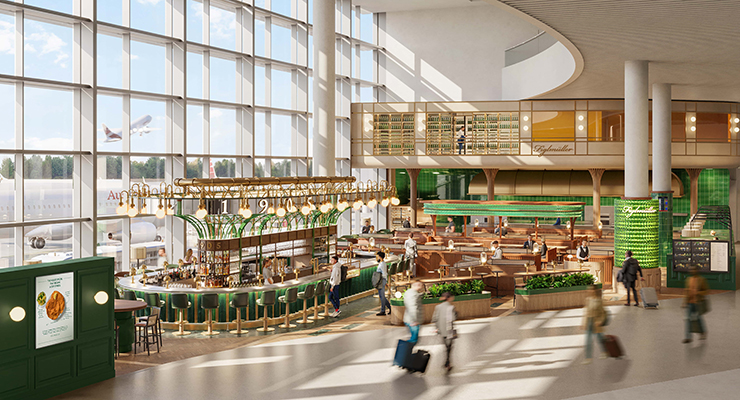
One of the clearest developments in airport F&B is the rise of local foodservice brands. Rather than encountering the same international chains at every airport, travellers are increasingly being introduced to the city, region or country they are visiting through its food and beverage offering. In this way, the airport is becoming an increasingly important showcase for the destination.
Vienna Airport, for example, features the renowned Viennese schnitzel restaurant Figlmüller, while Amsterdam-based bakery Koekemannetje has an outlet at Schiphol airport. At the airports in Bangalore and Mumbai, travellers can also find coffee bars operated by Mitti Café, an Indian organisation that creates employment opportunities for people with disabilities.
4. Technology is changing the business model
Airports are often ahead of conventional foodservice businesses when it comes to technology. Ordering kiosks, self-checkout and digital ordering solutions have already become standard features at many airport quick-service restaurants. This affects not only the guest journey but also restaurant design. Ordering counters can be made smaller, freeing up valuable floor space for food preparation, seating or other commercial functions. Digital ordering can also increase transaction speed, while self-service kiosks encourage customers to add extra items or upgrade their orders. Technology is therefore becoming more than just a solution to staff shortages: it is also an integral part of the business model.
5. Asia is taking over the airport food court
Asian cuisines are gaining ground across the foodservice industry. At airports, Japanese and Korean concepts are particularly well suited to travellers looking for flavourful, familiar dishes that can be served relatively quickly.Sushi has already become commonplace, but products such as onigiri, ramen and Korean fried chicken are also appearing more frequently. This is broadening the traditional airport offering of sandwiches, burgers and pizza.
6. Chicken is booming
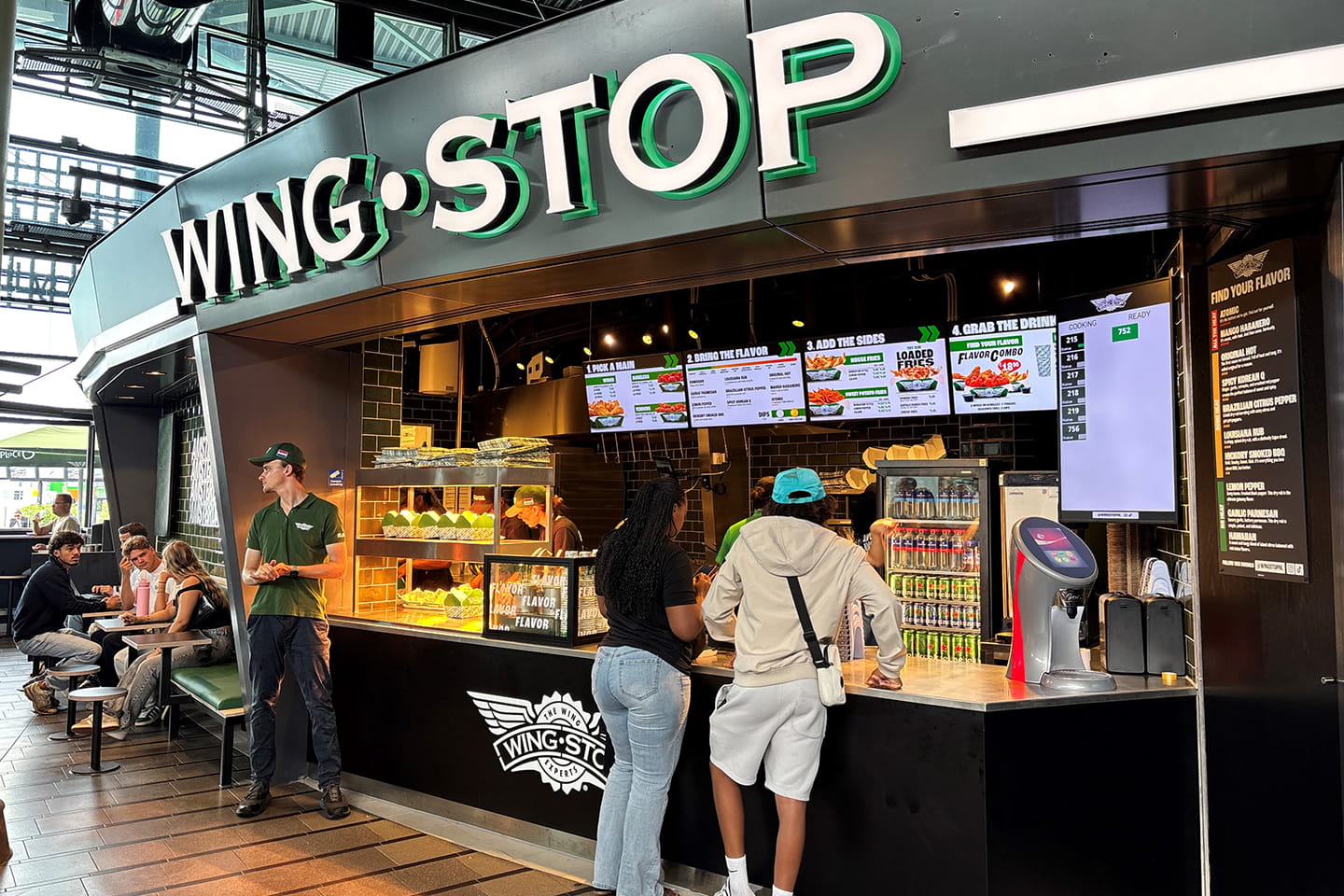
Chicken is one of the world's most accessible and widely accepted sources of protein. It is also an excellent fit for quick-service restaurants: it is familiar to consumers, relatively easy to share and adaptable to a wide variety of flavours and cooking methods. The growth of chicken-focused concepts is therefore also becoming visible at airports.
7. Airport lounges are becoming competitors to restaurants
A less visible development is taking place behind closed doors. The number of airport lounges is growing, while the quality of their food and beverage offerings is also improving. Particularly in Asia and the United States, lounges are increasingly evolving into fully fledged hospitality concepts where travellers can work, relax, shower and enjoy an extensive range of food and drinks. Access is no longer limited to business-class passengers and frequent flyers. More and more lounges are available through credit cards, membership programmes or a one-off day pass. For conventional airport foodservice operators, this creates a new competitive challenge. After all, a traveller who spends two hours in a lounge before departure, eating and drinking there, is no longer spending that money in the terminal.
8. Sustainability is shifting from ambition to strategy
Sustainability is becoming a more concrete part of airport F&B strategy. Issues such as food waste, packaging, energy consumption, carbon emissions and the balance between animal-based and plant-based products are increasingly being incorporated into tenders and concession requirements. Amsterdam Schiphol airport is also working to make its F&B offering more sustainable, with a focus on reducing waste and lowering its climate impact. The next step is to stop treating sustainability as a standalone programme and instead make it an integral part of concept development, product ranges, operations and procurement.
9. From a necessity to an integral part of the travel experience
For a long time, airport food and beverage was viewed primarily as a functional necessity. Today, it is increasingly recognised as an integral part of the overall passenger experience. The airport of the future will not simply offer more foodservice outlets, but a better mix: international brands alongside local favourites, speed alongside comfort, and familiar products alongside exciting flavours from around the world.
Reuvers explains: “The best airport F&B concepts emerge when you start not with the available floor space, but with the traveller. Who is passing through? How much time do they have? And what do they need at that particular moment? When you design your offering around these questions, F&B becomes more than just a commercial amenity. It becomes an essential part of the airport experience.”
.png)