Most consumers say they want to eat more sustainably, but when it comes to choosing a meal; taste, price, and convenience still come first. For Sodexo, closing that gap is the real challenge. The company is betting on a pragmatic approach: not forcing plant-based choices, but redesigning menus so that 70% of all meals are low-carbon by 2030 – without compromising on taste, flexibility, or business realities. Food Inspiration spoke with Etienne Dufrenois, Sodexo’s Head of Corporate Responsibility for Continental Europe, about chances and challenges.
Dufrenois has spent his entire career in food. “I wanted to become a chef when I was a kid,” he says. “I’ve worked in kitchens, in operations, in sales, in strategy – the past 25 years within catering services.” He also spent three years working for Sodexo’s philanthropic initiative, Stop Hunger, leading activities across APAC and MEA. For the last five years, he has led sustainability for Continental Europe. “As a company, we need to work with our entire ecosystem.”
That broad perspective shapes how he talks about climate ambition. Sodexo has committed to net zero by 2040, a target validated by the Science Based Targets initiative. But Dufrenois is careful not to frame the journey as a straight line. “Net zero is the North Star,” he says. “But on a day-to-day basis, we take it step by step.”
Key figures
Founded in 1966 in Marseille by Pierre Bellon, Sodexo Group focuses on two activities: Food Services and Facility Management Services.
-
€24.1 billion consolidated revenue (fiscal year 2025
-
426,000 employees (as of 31 August, 2025)
-
€6.5 billion market capitalisation (as of 7 January, 2026)
-
Active in 43 countries (as of 31 August, 2025)
-
80 million consumers served daily
From long-term roadmap to near-term action
Sodexo started its carbon journey in 2016, supported by a long-term roadmap under its Better Tomorrow 2025 plan. The company has already met – and exceeded – its 2025 targets for scope 1 and 2 emissions. “Additionally we have achieved a 19,1% reduction on scope 3 in 2025, which is the hardest part, representing 99% of our carbon footprint, including the products we buy,” Dufrenois explains. That makes the next step particularly demanding. “Our next near-term target is a 55% reduction for scope 1, 2 and 3 by 2030. Let’s be transparent: it’s going to be a huge challenge.”
Still, he sees that ambition as essential. “Without bold commitments, we would not have made this progress. It helps us engage people and raise awareness of where we need to act.” To make that ambition more actionable, Sodexo has shifted its approach. “Last year we launched our new roadmap: Better Tomorrow 2028. Instead of a ten-year plan, it’s now a three-year roadmap – more pragmatic, more hands-on, and more closely aligned with market dynamics and everyday operations.”
"Let’s be transparent: it’s going to be a huge challenge.”
Where the biggest impact sits
Sodexo knows clearly where the biggest carbon reductions can be found. “Almost half of our carbon footprint is related to animal protein: meat, fish, eggs and dairy. So the action that we need is clear. To drive change, that needs to change.”
That insight pushed Sodexo to revise its earlier sustainability targets. “Our previous targets focused on plant-based and vegetarian dishes, but we learned that this was a bit too dogmatic. By focusing on plant-based or vegetarian dishes, we were polarising the debate. It was basically vegans against carnivores.”
According to Dufrenois, those earlier targets did help accelerate cultural change. “It helped us drive change around plant-based food as a good alternative, but it also created tension – internally, with our clients, and with consumers. So we decided to adopt a more pragmatic and balanced approach.” That shift led to a new objective: low-carbon meals.
From plant-based targets to low-carbon meals
“The purpose is to offer 70% low-carbon meals, while 30% remain classic dishes with fish or meat at the centre of the plate,” Dufrenois explains. “You can have plant-based, vegetarian, plant-forward, and push that forward, but you can still have meat and fish dishes, just positioned and portioned in a different manner.” The point, he says, is flexibility without losing direction and using science as a backup.
“We created a low-carbon meal position paper (PDF), because right now, there is no universal definition of low-carbon meals. It explains what we do and how we measure.” Two years ago, while preparing the next roadmap and the next phase of its SBTi journey, Sodexo knew it no longer wanted to work with vegetarian or vegan targets alone. “So we started working with WWF, with whom we have a global partnership, to put in place a validated definition of low-carbon meals.”
Sodexo’s definition aligns with the 1.5-degree goal of the Paris Agreement. “It’s maximum 500 grams of CO₂ per main dish. And we have calculated that we need 70% of all our dishes to be low-carbon meals in order to achieve our net zero target by 2040.” But just as with net zero itself, Dufrenois stresses that the long-term goal and the short-term route towards it are not the same. “Our short-term 2030 target needs to be more pragmatic.”
Sodexo therefore made a deliberate choice. “We had two options. Either we changed the percentage of low-carbon meals for our near-term target for 2030, or we changed the grams threshold. We chose to keep the 70% target. But instead of going for 500 grams at once, we will first strive for a maximum of 900 grams by 2030.”
A new thermometer in the kitchen
For Dufrenois, this is where sustainability becomes operational. “Our target now is really to equip all our countries and our sites with low-carbon tools.” Sodexo works with global partners to obtain independent third-party validation of its data and progress. “We’ve run an audit with them to make sure they are aligned with the GHG Protocol and LCA calculations. We connect that with our supply data at ingredient level, and then they calculate the carbon footprint for one recipe, taking into account origin, product quality, and more.”
In Continental Europe, Sodexo works with Klimato and global partner Eaternity to measure and lower food-related emissions, dish by dish. Dufrenois explains it with a kitchen metaphor. “We are implementing a new thermometer in the kitchen. We already have the traditional Celsius thermometer for food hygiene and temperature control. We obviously have the ‘euro’ thermometer, because when you run a canteen, you need to cook on a budget. And now we have the carbon thermometer in the kitchen.”
That carbon thermometer is becoming a new KPI. “We are starting to deploy this KPI and learning how to measure it on a daily basis. It is a tool to empower chefs on site and to better equip our culinary teams that design the menu. It allows them to play with ingredients, adjust recipes, and optimize them.”
The next few years, he says, are about scaling that approach. “In the short-term plan, our goal is to deploy this methodology and these tools across our sites, and to raise awareness and train our chefs.”
Sodexo’s three key levers to sustainable eating
Sodexo focuses on three core levers to improve the sustainability of its food offering:
Better sourcing: Following its responsible sourcing commitments and engaging with suppliers. By 2028, 35% of Sodexo key suppliers will achieve an EcoVadis score of 65 or higher.
Lower CO2 per dish: Designing and optimizing recipes to reduce their carbon footprint
Reducing waste: Since 2019, Sodexo has reduced food waste globally by 48%. Further rollout of its WasteWatch program across all sites is expected to drive additional improvements
Focus on impact, not ideology
As a global food services company, Sodexo also has to navigate ongoing debates about foodmiles and local sourcing. Dufrenois is cautious about simplistic answers. “We serve our consumers on a daily basis, but we also work with clients who sign the contracts. So we need to make sure that we are aligned with their requirements. In a school, a hospital, a prison, an elderly home, or a corporate building, the parameters are completely different. At the same time, we play a critical role in supporting our clients and encouraging the transition towards more sustainable options.”
That is why, he says, pragmatism matters. “When you need to deliver food every day, you need to be pragmatic, not dogmatic. So we don’t ban products as such. Only for fish do we exclude certain red-listed species.”
Exotic fruits are a good example of how public perception and climate impact do not always align. “Think of mangos, bananas... Thirty percent of the global carbon footprint is linked to food production and consumption. If you look within that footprint, only 5% is linked to transport. That’s a very small share, and needs to remain small.”
That does not mean local sourcing is irrelevant. “Using local products gives us a strong story toward our consumers, and sourcing at a European level has clear advantages. But you simply cannot source everything locally. If you are in Sweden, you don’t produce everything in Sweden. So it’s important to take a broader, more continental perspective.”
The bigger issue is relative impact. “Cutting bananas from the menu because of food miles has very little effect. Reducing the volume of beef has a much greater impact on carbon emissions. That’s why having low-carbon tools helps us make the right decisions. The magnitude is simply not the same. Beef averages around 30 kilos of CO₂e per kilo of food, while fruits, vegetables and beans are typically around a kilo. Sourcing tomatoes from heated greenhouses in the Netherlands can be worse than importing bananas.”
Keep momentum
Asked whether it is becoming harder to maintain momentum now that sustainability receives less attention in public debate, Dufrenois acknowledges the challenge – but only to a point. “You are absolutely right, and yet the momentum is still there. We were at a large sustainability event in Paris recently, and one of the speakers said: yes, media and politics are talking less about sustainability. But in real life, nothing has changed.”
There is also a growing sense of urgency driven by real-world developments. “This morning I read an article stating that forest fires in Europe increased by 20% in one year. The same pattern goes for floods and droughts. This directly impacts food costs, production, and yields. Food companies are starting to see and feel this. Some big food companies acknowledge that if they don’t invest in sustainable farming practices, they can probably close business in ten or fifteen years. That reality is catching up with us.”
Internally, one of the strongest drivers of momentum comes from clients. “We see sustainability requirements in almost all Requests for Proposal. We have sustainability rankings, and now we even include sustainability clauses in contracts. In many cases, this means we must publish our carbon footprint at site level or align our actions with the Paris Agreement.”
That matters because food services play a significant role in a building’s footprint. “In a corporate building, the staff restaurant can represent 15 to 20% of total carbon emissions. Kitchens can consume five to seven times more energy per square meter than the rest of the building. For factories it’s different, but for offices, schools, and similar environments, we are a major contributor.”
Clients are increasingly aware of this. “They come to us and ask: can you help reduce our impact? And we say: yes, but we need to work together. We need to engage the consumer. It’s a decision we have to take together.”
From meat-centric to plant-centric
Still, the biggest challenge may be cultural rather than technical. “Right now, we are in a meat-centric culture,” Dufrenois says. “We love meat as individuals and as a society. Over the last 60 years, global meat consumption has increased fivefold, while the population has only increased by 2,5. So we have built a strong meat culture.”
Moving toward a more sustainable future requires a fundamental shift. “We need to move toward a more plant-centric culture. Meat will still be there, but in a different way. That’s a major cultural shift – for consumers, but also for chefs.”
He knows this from experience. “I was trained as a chef. In culinary school, we were taught to put meat at the center of the plate. It’s even reflected in language. In French, vegetables are ‘garniture’. In English, they are ‘side dishes’. That shows how deeply this thinking is embedded.”
Dufrenois often explains this transition using a simple metaphor. “We are currently in a room – the meat-centric room. Next door is another room: a future-proof, more sustainable room with a plant-centric approach. To get there, we have to pass through a locked door.”
To open that door, two things are required: willingness and knowledge. “It’s our responsibility to present a positive and inclusive food future. One where food is still delicious. Because if it’s not good, no one will choose it. Food is emotion.”
Inspiring chefs to cook differently
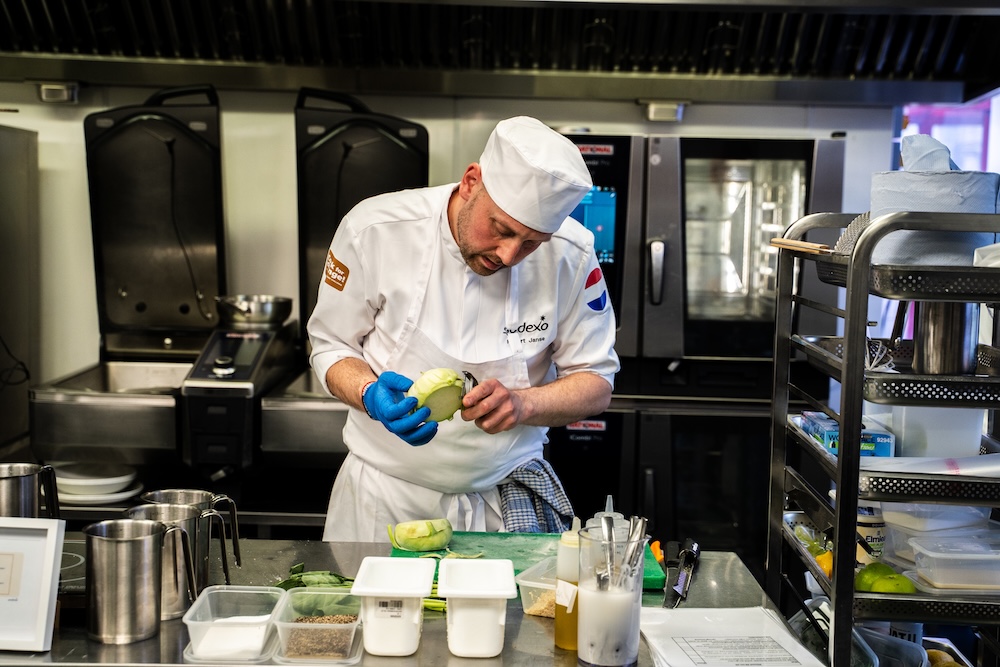
That is where Sodexo’s internal initiatives come in. “Cook for Change! is our internal sustainable cooking competition and a way to inspire our chefs community on how a plant-centric diet can be cool,” Dufrenois says. This year, the Dutch winner Robert Janse won with a plant-based kohlrabi dish. “In the end, it shouldn’t matter whether something is plant-based or not. It should simply be delicious.”
But inspiration alone is not enough. “If you want to move into the next room, you still need the key. And that means equipping our teams with the right tools and knowledge.”
That includes not only measurement tools and definitions, but also culinary skills. “Most chefs have been trained to cook with meat. Cooking with meat brings texture and it’s full of umami. The challenge is: how do you achieve the same result without meat?”
Sometimes the answer is surprisingly simple. “Take tofu. Plenty of chefs don’t know how to cook it. But if you explain that tofu is like a sponge, it becomes clear. You use the same techniques you already know. You marinate meat – so you marinate tofu. Then chefs can apply their existing skills in a new context.”
Sodexo supports this transition with tailor-made training programs such as “Vegetalizing.” “It’s about changing the mindset and putting plants at the center of the plate. We need to give chefs the tools to open that door.”
When that happens, the impact is immediate. “After two or three days of training, you see a spark in their eyes. They discover a new dimension. Chefs love to learn. It opens up a whole new culinary horizon.”
Cook for Change! Challenge
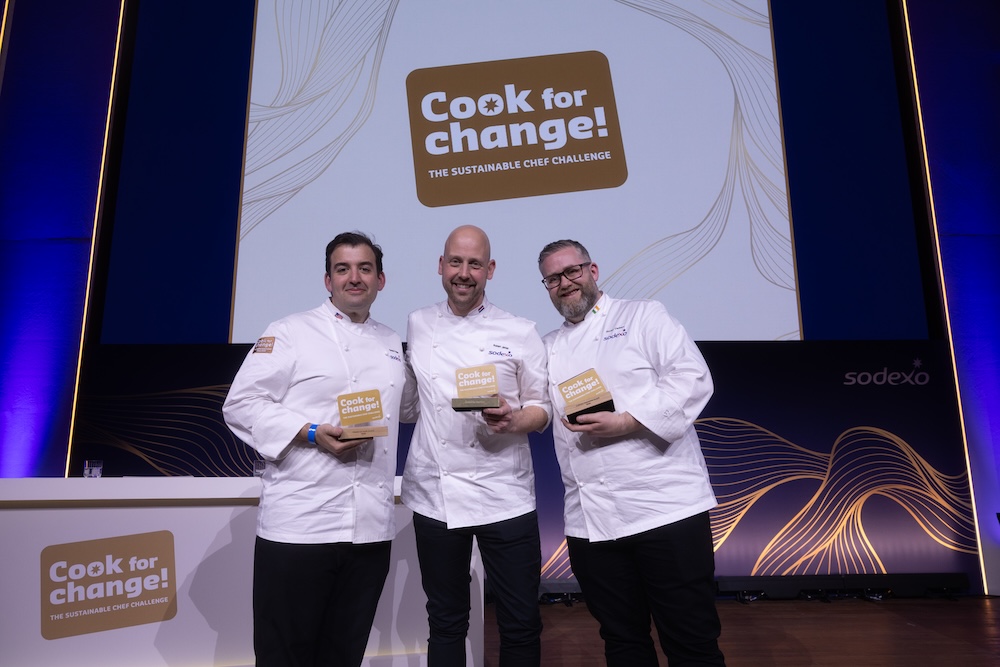
With this leading internal challenge, Sodexo puts the culinary talent of its chefs in the spotlight, rewarding those who create healthier dishes with a lower climate impact. After months of preliminary rounds, nine chefs from 30 countries reached the final, selected from a field of 500 participants. For the first time ever, a Dutch chef took the top prize: Robert Janse was named Global Sustainable Chef during the fourth edition of Cook for Change!
Three awards were presented during the final:
-
Chef of the Year 2026: Robert Janse (Netherlands), for his Smoked kohlrabi with miso, white bean cream and kombucha beurre blanc
-
Culinary Innovation Award: Gordon Carberry (UK & Ireland), for his Miso-roasted parsnip with parsnip textures, wild rice, crispy chickpeas and aquafaba mayonnaise
-
Scale Impact Award: Randall Prudden (United States), for his Whole pumpkin with roasted maitake mushrooms and mole negro
Why this matters for business
So what are the key priorities for the coming years? For Dufrenois, it starts with internal awareness. “When we talk about sustainable eating, many people think they already understand it. The first challenge is to make them realize they don’t. Our teams – chefs, site managers, catering staff – need to relearn and rediscover. Awareness is critical.”
At the same time, the conversation needs to move beyond purely environmental arguments. “We are not doing this just to support nature. It is a business imperative.” That business case is becoming increasingly clear. “It impacts our clients’ carbon footprint, and more consumers are actively looking for better alternatives. In Europe, around 30% of consumers are flexitarian, vegetarian or vegan. We need to serve them.”
There is also a direct link to health and productivity. “Sustainable eating often means healthier eating: more plants, e.g. vegetables, fruits, whole grains, nuts, pulses. That leads to more fiber, more vitamins, better digestion, better concentration, fewer sugar spikes. Ultimately, it supports productivity at work.”
For Sodexo, this expands its role beyond foodservice. “We support our clients beyond just providing food. One of the key priorities is to show that sustainability is not just about the planet – it’s about business performance.”
Too often, sustainability is still seen as a cost. “People think it’s business on one side and sustainability on the other, and that sustainability only adds cost. But often, what is good for the planet is also good for your wallet. We see that with energy use, for example. More efficient kitchens reduce both emissions and costs.”
Closing the intention gap
Sodexo’s International Sustainable Food Barometer highlights the core challenge. Dufrenois calls it the 'guest paradox.' "74% percent of consumers say they are positive towards sustainable food, and 79% believe action is urgent. But when they choose a meal, the main drivers are affordability, taste, and health – and only then sustainability.”
In other words: sustainability only works if it is the best option overall. “People will choose the sustainable option only if it is irresistible – affordable and delicious.” That is why Dufrenois keeps returning to one central idea. “Food is emotion. Taste remains the primary driver. That’s why I always say: deliciousness will save the world.” For Sodexo, that defines the mission ahead. “Our job is to close the gap between intention and behavior – to make low-carbon meals truly desirable.”